Articles

Ford pushes for Traffic Jam Assist

Image
Traffic Jam Assist is an intelligent driving technology that Ford is developing potentially for the mid-term (2017 to 2025). It uses radar and camera technology to keep pace with other vehicles and provide automated steering control to stay in the current lane, reducing driver stress and potentially improving vehicle flow. Individual simulation studies have found that where 25 percent of vehicles on a stretch of road are equipped to automatically follow the traffic ahead, journey times can be reduced by 37.5 percent and delays reduced by 20 percent. Traffic Jam Assist has the potential to follow the traffic ahead while maintaining lane position in environments where there are no pedestrians, cyclists or animals, and where lanes are clearly marked. Many of the sensing technologies required to deliver Traffic Jam Assist are already available on current Ford models including Focus, C-MAX and Grand C-MAX. Independent steering already features on Lane Keeping Aid, which provides steeri...

Driver Assistance: Cutting edge technology fort the mass market

Image
CESA Paper Abstract Driver Assistance Systems have evolved dramatically during the last decade. In the early stage their use was limited due to high cost und technological restrictions in the premium segment. Today we witness a massive rollout phase into every car segment. On the one hand this leads to higher volume on the other hand the accepted price from the customer is much lower than before without accepting too much compromises in functionality. This describes the challenge for OEMs as well as suppliers. One approach of Volkswagen is to constantly question today’s hardware concepts concerning sensors and electronic control units (ECUs) for driver assistance systems. E.g. high cost radar sensors dominate the market for adaptive cruise control and side assistance systems. Focusing on the demand of the customers in the volume market leads to a dedicated design which is more cost effective and allows reaching low end platforms. The goal here is not to switch sensor technology co...

eCall to become mandatory in all vehicles in 2015 in Europe

Image
The Transport Committee in the European Parliament supported the introduction of a mandatory electronic system of emergency - the famous eCall - in all new car models as from 2015. "ECall could save lives with relatively little effort", said Dieter-Lebrecht Koch, from Germany, Vice-Chairman of the Transport Committee in the European Parliament.

Automated braking systems in EuroNCAP ratings as from 2014

Image
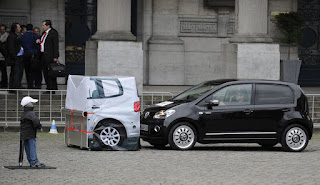
Euro NCAP is calling for car makers to do more to help reduce Europe's road deaths by fitting AEB (autonomous emergency braking) technology as standard to new cars. The independent safety organisation says that the industry should do more to promote the technology, which can save thousands of lives each year. AEB systems will be included in the Euro NCAP star rating as from 2014. Research suggests that Autonomous Emergency Braking systems can reduce accidents by up to 27%, saving around 8,000 lives and preventing many more serious injuries and whiplash claims each year. Despite this, the technology has only been made available on around 20% of new cars and many manufacturers do not offer the technology at all.

Cars 21 reports a vision for 2020

Image
As part of the Commission's modern industrial policy, the CARS 21 (Competitive Automotive Regulatory System for the 21st century) made recommendations for 2020 to reach new heights. It's a call for rapid progress on important subjects such as electro-mobility, road safety, market access strategy and a review of the CO2 emissions from cars and vans. Cars 21 claims the roll out of alternative infrastructure to support new energies, standardisation issues for the breakthrough of electrical cars, the EIB financing for research, a new driving test-cycle and test procedure in order to reduce CO2 emissions, as well as ICT technologies supporting driver behaviour and road safety. The car of 2020 should be clean, fuel-efficient, quiet, safe and connected.  Link : http://cesa-automotive-electronics.blogspot.fr/

CESA 2012 interview : Rémi Bastien (Renault), third part

Image
Rémi Bastien is Vice President for Research, Advanced Studies and Materials at Renault. For this third and last part of the interview, he discusses about CESA congress and the french know how. "As a shareholder of SIA*, I was one of the promoters of the CESA congress. The first edition in 2010 was rather successful and we have decided to continue. A scientific congress is much more a tradition in Germany, where engineers like to share information, than in France. However, we have good scientists too and it's an opportunity to present research labs, universities and to put the emphasis on french know how in the whole automotive industry. We have for example the VeDeCom institute, housed by the Mov'eo cluster and which is very unique in Europe. It's the only place you can find OEMS, suppliers, labs, famous research firms (CEA, IFP, IFSTTAR), and outside automotive companies such as Veolia or EDF, working all together on carbon free vehicles and new mobiliy trends. ...

CESA 2012 interview : Rémi Bastien (Renault), second part

Image
This is the second part of the interview of Rémi Bastien, Vice President for Research, Advanced Studies and Materials at Renault. The internal code name for this organisation is DREAM. So, let's dream of the future with our top expert. "With this research organisation, we try to make our managers dream, and then our customers. More seriously, we drive half of the innovation at Renault. We are working on early stage on breakthrough innovations, whether it's on powertrain, or for the connected car. To give an example, we have created the embedded charger on Zoe EV car, wich is called Cameleon and allows to charge more quickly. This device is compliant with power from 22 to 43 kW. One of our challenges at the moment is to develop more affordable batteries, always for EVs. We expect to be ready in 2017, with next generation batteries which would allow the same range, from 150 to 200 km, but with a much lower price. Another interesting topic is the driving assistance. Toda...